
By J.J. Hurtak, Ph.D., Ph.D., and Desiree Hurtak, Ph.D., MS. Sc.
 At any minute (starting 6th of March 2015) Jet Propulsion Lab scientists could be receiving a startling confirmation on vast water reserves on the dwarf planet Ceres as a result of the remote sensing technology onboard NASA’s Dawn Probe dawn.jpl.nasa.gov/. After some 3.1 billion miles, the spacecraft will answer questions on the nature of Ceres, particularly on the interior of a space object that may be 25% water. Dawn is already in orbit and making its spiral down to the surface of Ceres where it will take an investigative look at this icy world that some scientists believe could house primitive forms of extraterrestrial life under its surface. Ceres, the largest object in the asteroid belt, and its neighbor, Vesta, the second largest object in the area, may also provide vital clues on the nature of the asteroid belt between Mars and Jupiter that was formed out of debris encircling Jupiter from an earlier time of our Solar system. Some claim the asteroids are the result of a planet that was destroyed in the distant past. Now these two sisters have been classified like Pluto, as dwarf planets.
According to Carol Raymond, a planetary scientist at Cal Tech’s Jet Propulsion Lab, these are exciting details about two intact proto-planets that have existed “from the very dawn of the solar systems… they are [in fact] two fossils we can investigate to understand what was really going on at that time.” Ms. Raymond is in charge of JPL’s program for studying small solar system objects in Pasadena, California.
It will not be sending back pictures or data until late April (2015), when it reemerges from Ceres’s dark side. Then, the Dawn spacecraft is expected to measure the surface features of Ceres, especially the shapes and size of the numerous craters that pock mark its surface. Scientists believe that Ceres has something like 43 million cubic miles of water and most of it is probably frozen. According to several planetary scientists, Ceres is unlikely to have a liquid layer. Raymond also says, “One of the intriguing questions is whether that ice retains enough heat to be subject to convection.” The European Space Agency’s Herschel Space Observatory last year (2014) detected water upon Ceres by using a space-based infrared (IR) telescope.
These findings come at a time when other NASA’s current programs (2015 data from Keck and Infrared Observatories in Hawaii) on the study of Mars have confirmed a more massive oceanic system on Mars that had existed in its distant past. New data reveals a global covering of water once existed on Mars reaching a depth between l30 and 137 meters over the entire surface of the red planet for a period of a million years, enough water and time to start life. This matches the planetary data the authors (Drs. Hurtaks) covered in a conversation with NASA scientists back in August of 2001 at a conference where we were guest speakers.
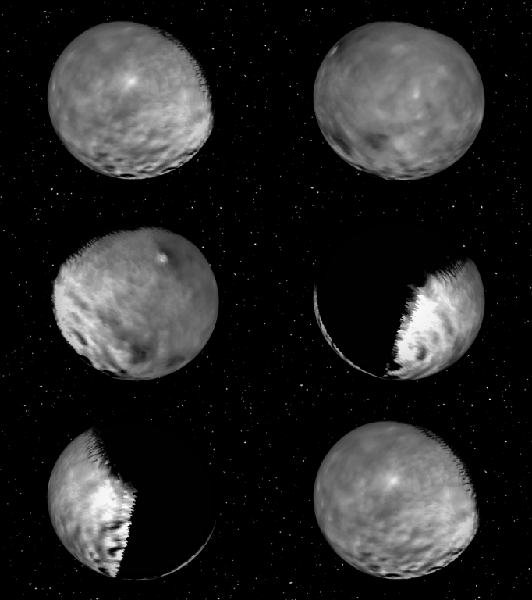 The recent probes announcing the findings of massive water on the tiny Ceres and Mars in our Solar system bring us one step closer to an official announcements of finding exo-biological life forms in our own backyard. These findings come as no surprise to us, particularly to the thousands who were listening to us in our historic conversations on Televisa broadcasts worldwide on Mars with legendary journalist, Pedro Ferriz, and at several major auditoriums in Mexico City back in 1985. More recent updates have been made through journalist, Jaime Maussan in 2013 and 2014. Throughout the world, our lectures on “Life on Mars” for the last forty years have given factual clues and actual close-up pictures (Mariner-9) of massive water spillways and river systems that gave Mars its unusual network of canal-like features and oceanic water system that could have triggered Life millions of years ago. NASA can now start counting on its fingers the number of planets and dwarf plants that have potential for life in our Solar system.
Let us reflect on one saying of Metrodorus, a 4th century philosopher from Chios, Greece, regarding the abundance of life that we must adjust our eyesight to the heavens with these words: “To consider the Earth as the only populated world in infinite space is as absurd as to assert that an entire field sown with millet, only one grain will grow.”
Watch for announcements on evidences of life beyond Earth coming in May 2015.
Image credit: NASA/JPL-Caltech/UCLA/MPS/DLR/IDA


 NASA’s Cassini spacecraft is currently orbiting the ring system of Saturn. It has been on an extended mission since 2008 and amazingly continues to send back advanced data on Saturn, its moons and extensive ring system. The ring system has proved most amazing as it contains myriads of ringlets, moonlets composed of dust and icy rocks. It operates as an accretion disk with primordial matter, ice and micro debris. What is most interesting is that the rings are not as stable as they have appeared. Originally, the rings were observed by the Voyager mission when it passed by Saturn (1980-1981), but a comparison with the Cassini images has revealed great differences in almost all the rings, especially the F-ring, over the period of less than thirty years. Thus, in a relatively short period of time the vast changes in the rings have shown spectacular morphologies.1
 The analysis of the changing rings has become one of the most important topics surrounding Saturn over the past 7 years. Not surprising, The Keys of Enoch® proposed that Saturn would be a sign of change, revealing how we, the human race, should take a closer look at our evolving Solar system. Specifically, Key 304:11- 12 tells us: “Our sun, by virtue of being a variable star, will be seen as having great limitations for future evolutions. This will be observable by visible exchange of the solar polarity fields and by the magnetic mapping of inner-solar magnetic lines rotating faster than the surface of the sun. These changes will also affect the rotation of Saturn. This will be seen as a periodic effect which will be noticed in the activity of Saturn’s rings. It will illustrate new changes that will take place throughout the entirety of the solar system.”2
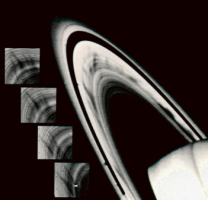 It is fortunate that we have a 30-year comparison made by Voyager (1980-81) from colleagues at JPL and the team of Dr. Jim Warwick in Colorado. So why are the rings revolving and changing into strange patterns? Theories still abound. The answer to these deeper questions may lie in the nature of the outer planets and especially how the rings themselves seem to have rain affecting Saturn’s ionosphere.5 Saturn’s moon Rhea may also have rings around it, although this has not been confirmed. The rings of Saturn themselves although varying in width are incredibly thin, ranging from about 30 feet (10 meters) to several kilometers thick at most. The rings have slight pink, grey and brown colors due to the presence of dusty material mixed with the water ice.


 In 1979, Alan Guth (now at MIT), proposed the concept of cosmic inflation. He believed that the initial energy of the universe would cause a runaway expansion. Until recently it has been theoretical although mathematically proven that the universe is inflating.

 As many pathways of knowledge are now coming together, we wish to affirm a common basis for science, medicine and spirituality -and that common basis is a higher consciousness connected with what we call the “embodiment of Light” or the Light Body. We are an open-ended system, not limited in our ability to work only with the biochemical body and the psychochemical body, but capable of expanding those pathways into what we call the eka body of many plus and minus relativities, both in and beyond this physical form.

 A new machine called “Hogan’s Holometer” presently being built at Fermilab will measure more precisely than any hitherto constructed the odd noise signals detected in previous searches for the gravitational waves (and their concomitant space-time ripples) that are theoretically emitted in the violent collisions between black holes and supernovas.The interesting thing about the noise emissions which precipitated the building of the Holometer is that according to Dr. Hogan, physicist directing its construction, the anomalous signals may indicate “microscopic convulsions of space-time”—i.e., at the quantum or micro-level. This possible quantum effect is not yet empirically proven, and remains theoretical until the new machine provides more data. However, because scientists were previously looking for a larger (macro) effect in the matter-energy continuum of a disturbance from a far-away cataclysmic stellar collapse, to have preliminary data point to its effect upon the sub-atomic particles must beg the question: how does the information (the ‘news’, as it were) of a distant stellar event show up in the subatomic particles if it is not ‘relayed’ through matter in space in a linear fashion? It could only do so if what happened at a distance (the disturbance) took place simultaneously within the tiny particles, meaning that the universe is holographic in nature.

 Perseus, the brightest cluster of galaxies in the X-ray region, located some 250 million miles away has at its center a black hole. The Chandra X-ray Observatory has discovered that surrounding the black hole is a ripple effect of waves of hot cluster gas. According to NASA, these ripples can create sound waves as they travel hundreds of thousands of light years away from the cluster’s central black hole.

 There may be three times as many stars in the known universe as the number previously calculated, according to new research done at the Harvard-Smithsonian Center for Astrophysics in Cambridge, Massachusetts. Astronomers have until now used as a yardstick the number of brown dwarfs in our own Milky Way Galaxy to calculate the number of stars in all the other galaxies, but that yardstick may not be reliable.
