 It must be remembered when considering its prophetic statements that The Keys of Enoch® was first published in 1973 following the physical biolocation of the author into a higher state of existence during the New Year period of 1972-73, an experience which is fully described in the introduction to this unique work. While under the protection of a “Light being” who identified himself as the biblical Enoch (the seventh patriarch from Adam), and later with the angelic being called Metatron, the author states that the information now published in The Keys was coded directly into his brain through scenario abstracts or light-pictures.
Many of the myriad scientific predictions contained in The Keys have since been validated. For example, the statement by Enoch in The Keys that tells us “our universe began on a spiral rather than a steady state or Big Bang,” is one definitive precursor (written in 1973) of scientific theory related to the self-reproducing inflationary universe brought forth as a working model in the 1990’s.
The first three “keys” (1-0-1, 1-0-2, 1-0-3), in fact, refer specifically to an “open-ended universe,” and it is most interesting to note that some eleven years after their publication, Professor John Schwartz of the California Institute of Technology, as guest lecturer, addressed a Winter School for Physics symposium in Israel on the universe as being “finite but unbounded”–which was recorded in the press at the time as one of the first lectures ever on this new concept.
Other Keys predictions relate to such subjects as thermodynamics, astrophysics, anthropology, biophysics, subatomic physics, magnetism, solar and other new power sources, zero point energy, psychotronics, medicine and healing, earth cataclysms, archaeology, and galactic events, including the location in 1978 by scientists at the California Institute of Technology of a “compact object that shoots out matter and energy along a narrow jet six light years long” (Key 1-0-6).
 The Book of Knowledge: The Keys of Enoch®also brings forth the position that cosmogonic activity created “physical matter” and the physical universe at a much later date than cosmologists had speculated until similar data came back from the Hubble Space Telescope. Now it is believed that the universe is only 10-14 billion years old, a far cry from the 20 billion year dating that most astrophysics had for a long time comfortably accepted.
Closer to home, The Book of Knowledge, relates extensively to the land of Egypt and especially the Great Pyramid, which “is an enlarged duplicate of the carbon atom.” This was confirmed by the notable Swiss theoretician Jules Muheim. Prof. Muheim agrees with The Keys of Enoch®when it indicates that the Great Pyramid is also the magnetic model of the human body and “contains the mathematics of the human heart beat” in stone. Similar unique crystalline, pyramidal forms can also be found in our human blood in particles containing all the mathematics of DNA-RNA which makes physical life possible on this planet.

We appreciate your interest. The Academy is a nonprofit organization. Please consider making a donation through our secure web server or by postal mail. We are always happy to receive extra contributions because they help us maintain our work around the globe. Your support is absolutely necessary to continue to make this possible.
You can always help — you can always pray.


 Picture taken aboard a Brazilian Naval ship in 1958 by Almiro Barauna, a professional photographer.

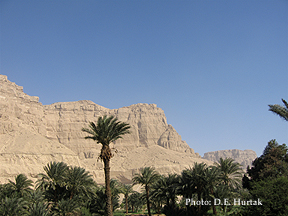 The provocative world news release (April 2006) on the themes found in the recovery of the lost Gospel of Judas (Iscariot) was not unexpected for those who have been working with the lost Coptic texts for the last thirty years or more. The Gospel recently resurfaced in New York in February 2006 but was originally discovered along the Nile River near the city of El-Minya about 120 kilometers south of Cairo in the 1970s. It coincides with the bulk of the Nag Hammadi corpus and slowly published by scholars in Berlin (1950s), at UNESCO, and at the Institute of Christian Antiquities in California which hinted at controversial sayings and works on the life of Jesus Christ and his disciples.


 The Los Lunas stone (located a few kilometers from the small city of Los Lunas, New Mexico) stands as a witness of what many scholars regard as the first “star map”and “religious testimonial” connecting the Old World with the New World. According to the late Dr. Cyrus Gordon, professor of Brandeis University and Harvard University, the stone authentically depicts a date equivalent of September 15, 107 BCE in a version of paleo-Canaanite or “old” Hebrew script. The orthography and aesthetic balance of the letters suggest the work of “unknown” scholars acquainted with the traditional Ten Commandments recognized in the pre-New Testament period by special people who had a reason to “stake out” this area in relation to the Holy Land, or who had been so inspired to leave behind a witness of Israel in the New World.
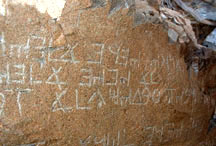 Most anthropologists feel that the stone shows the Ten Commandments in paleo-Canaanite or “old” Hebrew script and is the work of rabbinic scholars or cartographers who were taught by rabbinic authorities who had to leave Portugal or Spain in the 16th century. It would not be uncommon to mark the “edge” of the New World Empire with ancestral words of God’s Providence and power since the New World was divided between Spain and Portugal. The commandments in this context stand as a type of “mezzuzah” on one of the mount gates for the official ground or territory of the new empire was “staked” for all to acknowledge. In fact, the first governor’s home built in North America was nearby at Sante Fe.


 IKI in Moscow (the Institute of Space Research of the Russian Academy of Sciences, the Soviet equivalent of NASA) had hoped that, just as the Soviet Vega spacecraft which flew close to Halley’s Comet in 1986 and took 10,000 instrumented observations, detecting grains of ice and dust, the very elements essential for life (hydrogen, oxygen, carbon and nitrogen), similarly the Mars Phobos II probe would also find signs of primitive life. But in March of 1989 the Russian spacecraft Phobos II, programmed for intensive studies of the geology of the red planet, disappeared from the Russian tracking system as it was performing a preliminary survey of the Martian surface. This was the most sophisticated, powerful and costly package of Soviet and European electronics and instrumentation sent to Mars from the Earth prior to 1993 and was expected to perform over thirty joint Russian-European experiments when all its cameras shut off suddenly and the “total loss of the craft” was officially noted.
 One of the last images relayed to earth in detail by the Phobos II camera before data transmission was lost was an enormous elliptical shadow on the surface of Mars — cigar-shaped, and an estimated 25-27 kilometers (approxi- mately 16 miles) in length. The size of this object ruled out the possibility that it was a reflection of the Phobos spacecraft itself. Because of its of its position, its symmetrical shape, its size and its movement, no features on the surface of Mars in the area in front of the probe, nor the satellite moons of Phobos and Deimos, nor the Phobos II spacecraft itself could account for this shadow pattern occurring in the very last frames of data successfully transmitted to earth.
 The sighting of the shadow on Mars should be enough to convince many that there may be intelligent life orbiting Mars, but in August of 1993 another event of major proportions took place that sent a tremendous rumble through the US space program. The $400,000,000 US Mars Observer probe, sent to map in detail the surface of the red planet, was lost just as it prepared to make its Mars orbital insertion. Signals were sent to pressurize the fuel tanks in the propulsion system, in preparation for rocket firings that would slow the spacecraft down and allow it to be captured by the planet’s gravity field, but the Observer’s antenna, which was to receive and acknowledge Jet Propulsion Laboratory’s signal, never responded. Scientists concluded, a short time after the loss of the probe, that the spacecraft must have exploded when the fuel tanks were being pressurized. The cost of the entire mission was close to one billion dollars.

 The purpose of the first several human missions to Mars will be to follow up on the robotic explorations and to answer, above all, the question of whether or not the Red Planet has ever harbored life. In this process, the earlier missions of Mariner 9 and Viking l and 2 recorded landforms that suggested questionable details of earlier life.The Book of Knowledge: The Keys of Enoch® was the first book to ever publish unique landforms on Mars, specifically the four tetrahedral structure on the Elysium Quadrandle. The Academy also published the first Viking pictures materials regarding the unique artifacts in the Cydonia area including the co-called Face of Mars.
 Orbit 220, Range 441.21 km; (see left) Resolution 4.32m/pixel — has a swath of enhanced visualization covering an area of 4.42 km x41.5 km, taken on April 5, 1998, and shows a strange geometry with 21 white lines in parallel alignment
 Until humans arrive, software engineers have developed intelligent mechanistic robots who act as dune drivers that will collect panoramic images in a small section of the ground with a stereo camera and, with the assistance of earth-based engineers, allow for patching the pictures together into a 3-D virtual environment using software and an advanced VR interface called Marsmap. A small rover with a stereo camera that collects images of geologic terrain will be able to range as far as 100 kilometers from the landing vehicle. As the images of particular sites are gathered, they will become a rich resource for researchers wishing to explore particular landscapes of Mars in detail.
 The hard-hitting questions as evidence of earlier life on Mars cannot be answered by one or two fly-over missions or a few rovers and can only be put to rest if the international space agencies begin to take a serious look at the equatorial areas as former faces of vast water flow and the mechanisms for primordial organo-synthesis possibilities for the presence of life, or in the so-called “Inca City” region, where honeycomb configurations of geological cells and water-lines remind one of similar regions reviewed by radar experts over Guatemala and Belize in the late 1970s that confirmed man-made canals.

 Copyright © 2006 Dr. J.J. Hurtak, Ph.D. and D.E. Hurtak

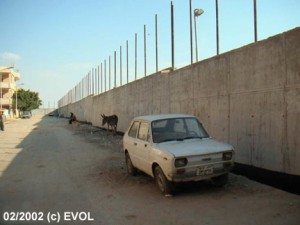
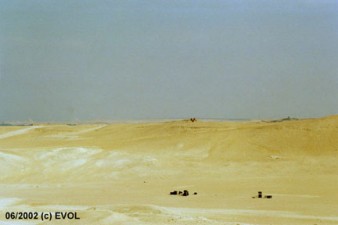
 Since the beginning of 2002, Dr. J.J. Hurtak and a European team of investigators and explorers have been recording the construction of a massive system of walls being placed around the historic pyramidal sites and the larger unexcavated area of Giza, Egypt — in total, an area covering approximately eight square kilometers. Why build these massive walls at this time? Certainly Giza is one of the finest archaeological zones of the world. Are there new treasures of ancient Egypt yet to be uncovered that require sophisticated technology and surveillance platforms, to protect the ongoing research along the Giza plateau? Has, perhaps, an area been discovered that shows tracings of rare earths and unique minerals? Or is it simply, as some officials are claiming, a move to protect the plateau from terrorists and control the masses of tourists visiting the area?
 The walls have been built in stages. Images taken in February of 2002 reveal the walls extending far out into the desert where, for the most part, they have not been noticeable to the average visitor. Note the foundation and the massive re-bar supports. The walls have been carefully constructed on a deep and wide foundation (at least 2 meters below ground) with iron rod poles poised to support the concrete interfaces, with room for a special attachable cover. All in all this suggests a gargantuan wall.
 The psychological reality of guards stationed as sentries at intervals along the entire wall carries the intrigue of a major feature film set, designed for the few experts who are to find an underground sphinx or obelisk, or a connection between Osiris and the constellation of Orion, rather than an open-door feature for thousands of well-behaved international students of history and archaeology who have never needed to be extensively controlled.